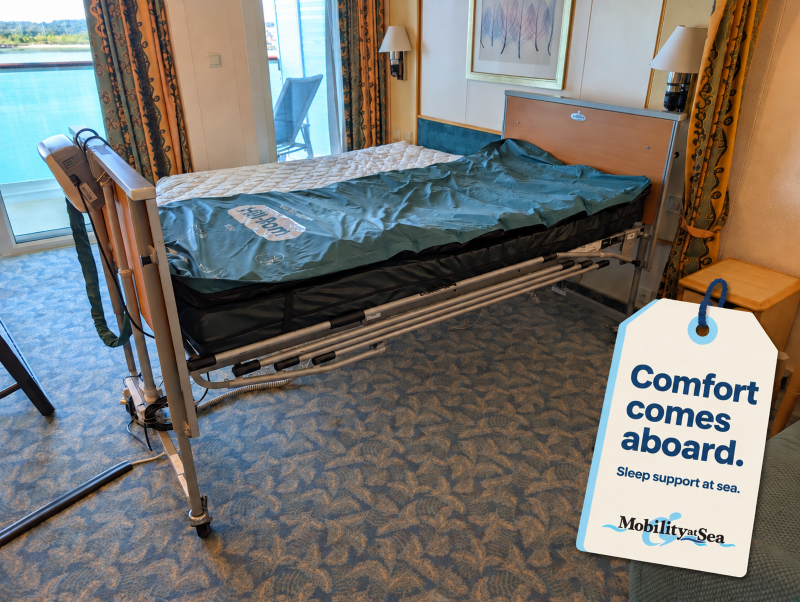
A cruise cabin should feel like a place to rest, not another obstacle to manage. For passengers who find standard beds difficult to get in or out of, need help changing position, or rely on care equipment at home, the right cruise sleep equipment can make a meaningful difference to comfort, safety and confidence throughout the holiday.
Sleep needs are personal. One person may need a firmer, adjustable bed position to reduce breathlessness or discomfort; another may need support transferring safely at night. Planning this before sailing gives the cruise line, your equipment provider and anyone travelling with you time to make suitable arrangements.
Why sleep arrangements matter on a cruise
Cruise cabins are designed to use space efficiently. Even accessible cabins can vary considerably by ship, deck and cabin category. A standard fixed bed may be at an awkward height, positioned close to a wall, or leave limited room for a carer to assist. Some beds can be separated into twins, while others cannot. These details matter when mobility, pain, fatigue or personal care needs are part of daily life.
Poor sleep can also affect the rest of the holiday. When getting comfortable takes too much effort, or a passenger worries about transferring safely during the night, it can leave them tired and less able to enjoy meals, entertainment and time ashore. Appropriate equipment is not about making a cabin feel clinical. It is about retaining the routines and support that help someone feel settled.
It is particularly worth discussing sleep arrangements if the passenger has reduced mobility, a recent injury, arthritis, neurological conditions, pressure care needs, or requires assistance from a partner or carer. A short cruise may seem manageable without extra support, but fatigue and an unfamiliar environment can make usual tasks harder than expected.
Cruise sleep equipment to consider
The best choice depends on the passenger, their usual routine and the space available in the confirmed cabin. An experienced provider will ask practical questions rather than assuming one product suits everyone.
Profiling beds for positioning and easier transfers
A profiling bed allows the backrest and leg sections to be adjusted, helping the user find a more comfortable position for sleeping, reading or resting. Raising the backrest can be useful for passengers who experience breathlessness, reflux or difficulty lying flat. Adjusting the height may also make transfers safer and reduce strain for a carer.
For some people, a profiling bed is essential equipment rather than an added comfort. It can support independence by allowing the passenger to sit up gradually before standing or transferring to a wheelchair. However, it requires careful planning. The cabin must have sufficient floor space, suitable access for delivery and installation, and a layout that allows safe movement around the bed.
Pressure care and a familiar sleeping position
Passengers who spend extended periods in bed, have fragile skin or are at risk of pressure damage may need additional pressure care support. The exact solution should be based on professional advice and the person’s established care plan. It is wise not to change a carefully managed routine simply because a holiday is approaching.
A mattress system, pillow arrangement or positioning aid that works well at home may not be appropriate for every ship or cabin. Speak to the equipment provider early, explain what is used at home and share any relevant requirements. They can then advise on what may be suitable for the voyage and what information the cruise line needs.
Bed rails, transfer aids and bedside support
Some passengers do not need an adjustable bed but do need a more secure way to get in and out of it. Bed rails and transfer aids can provide a useful handhold and improve stability when used correctly. They are not suitable for everyone, however. For a person at risk of becoming trapped, confused or trying to climb over the rail, another approach may be safer.
Bed levers, rails and similar aids must also be compatible with the bed frame supplied in the cabin. Cruise beds are not all constructed in the same way, so suitability cannot be assumed from a photograph. A clear assessment of the passenger’s needs and the cabin set-up is far more reassuring than taking equipment that may not fit safely.
Hoists and stand aids where care is required
Where a passenger needs help with transfers, a mobile hoist or stand aid may be part of their usual care routine. These larger items need especially careful co-ordination because of cabin dimensions, turning space, safe working load and storage. The needs of the passenger and the person assisting them should both be considered.
A hoist is not interchangeable with a stand aid. A stand aid may be appropriate where the user can bear some weight and participate in the transfer; a hoist may be needed when they cannot. Choosing the wrong equipment can put both people at risk, so specialist guidance is essential.
Check the cabin before arranging equipment
The ship’s accessible cabin is the starting point, not an afterthought. Before arranging cruise sleep equipment, confirm your cruise line, ship name, sailing date, cabin number or cabin category, and whether the cabin is fully accessible. It also helps to know the bed layout, door widths and whether there is room beside the bed for a wheelchair, walking frame or carer.
Do not rely only on a general deck plan. Ask the cruise line for cabin-specific information if your needs are more complex. In some cases, photographs, measurements or a written description of the layout may be available. The more accurate the information, the more confidently an equipment specialist can advise.
There are practical questions that are easy to overlook: Will the equipment fit through the cabin door? Can it be positioned without blocking the route to the bathroom? Is there enough turning space for a hoist? Where will a wheelchair be kept overnight? Is power required, and has the cruise line approved its use? Addressing these points in advance avoids stressful decisions at the port.
Arrange support early, especially for specialist items
Availability, ship approval and delivery arrangements can all take time. This is why it is best to start the conversation as soon as the cruise is booked, particularly when a profiling bed, hoist, stand aid or several pieces of equipment are required. Sailing from Southampton, Portsmouth or Tilbury can make port co-ordination more straightforward, but every booking still needs individual checks.
Mobility at Sea can help passengers and families consider what is practical for the sailing, co-ordinate delivery and collection, and provide cruise-specific guidance. The aim is not simply to place equipment in a cabin. It is to ensure the arrangement supports a safe, comfortable holiday from embarkation onwards.
If a passenger uses equipment prescribed or recommended by a healthcare professional, keep those recommendations to hand. It may also help to explain how the equipment is used in everyday terms. For example, whether the person transfers with assistance, needs to sleep with their upper body raised, or cannot walk to the bathroom unaided. This gives a clearer picture than a product name alone.
Make the cabin work for night-time routines
Once the equipment is arranged, think through the whole night-time routine. A wheelchair or rollator should be within safe reach but not obstruct access. Medication, a drink, glasses, a call bell or personal alarm should be easy to find in low light. If a passenger uses incontinence products or needs support to reach the bathroom, discuss the layout and any toileting equipment requirements at the same time as the bed arrangements.
Carers should consider their own position too. They need enough space to provide assistance without twisting, reaching awkwardly or lifting unsafely. A cabin may look spacious when empty but feel very different with a profiling bed, mobility aid, luggage and two people moving around it.
It is also sensible to pack familiar sleep essentials where possible, such as preferred pillows, nightwear and any non-electrical items that help the passenger settle. Familiarity can ease the first night onboard, when new sounds, movement from the ship and an unfamiliar room can disturb sleep.
Questions families often ask
Can standard cruise beds be adjusted?
Some cruise beds can be arranged as twins or moved by the ship’s team, but this varies by vessel and cabin. They are not normally a replacement for a profiling bed where adjustable positioning or height is required. Always check the specific ship rather than assuming arrangements will be the same across a cruise line.
Is it safe to take a bed rail on a cruise?
It can be, provided it is suitable for the passenger and compatible with the cabin bed. Bed rails must be assessed carefully, particularly where there is a risk of entrapment or falls. A specialist can help identify whether a rail, transfer aid or another solution is the safer option and is compatible with the specific cabin bed.
When should we book equipment?
Book as early as possible after confirming the cruise. Early planning is particularly valuable for larger equipment and accessible cabins, as it allows time for approvals, suitability checks and port delivery arrangements.
A good night’s sleep can change the feel of an entire cruise. With the right support in place before you travel, the cabin can become a comfortable base for each day at sea, rather than a source of worry.