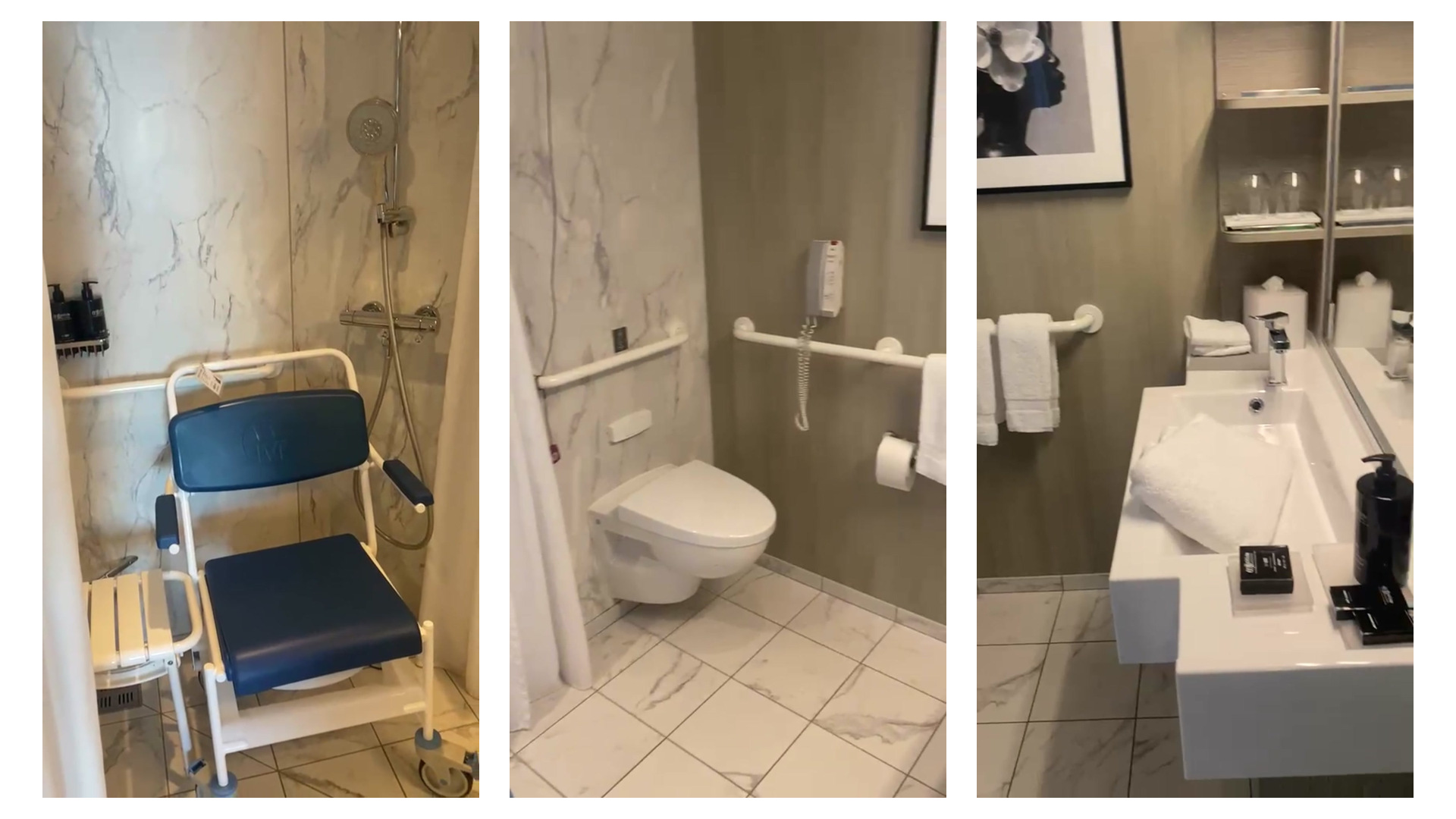
A bathroom can make the difference between feeling independent in your cabin and needing help with every part of your daily routine. Accessible cruise bathrooms are designed to offer more space and support, but the layout, fittings and practical suitability can vary considerably between ships, cabin grades and cruise lines. Looking beyond the phrase ‘adapted cabin’ before you book gives you the best chance of a comfortable, dignified holiday.
Why accessible cruise bathrooms need a closer look
An accessible cabin is not always a perfect fit for every passenger. One guest may need clear turning space for a mobility scooter or wheelchair, while another may be able to walk short distances but need a shower seat, grab rails or support when transferring. Someone travelling with a carer may need enough room for two people to move safely around the bathroom.
Cruise ships also have physical limitations that hotels on land do not. Cabins are compact by nature, and accessible bathrooms have to work within the structure of the ship. Many are well planned, with level-access wet rooms, fold-down shower seats and handrails. Others may meet accessibility requirements but still feel tight for a larger powered wheelchair, a shower commode chair or a passenger who needs assistance.
The key is to match the cabin to your needs rather than relying on a general accessibility label.
What to ask about before booking
The cruise line or travel agent should be able to provide information about the specific accessible cabin, rather than just the ship. If possible, ask for a floor plan, photographs and measurements. This is particularly valuable if you use specialist equipment or have limited ability to stand.
Start with the bathroom door. Ask about the clear opening width, whether the door opens inwards or outwards, and whether there is a raised threshold. A doorway that seems wide enough on paper can be difficult to use if the approach is narrow or the door swings into the available turning space.
Then consider the shower arrangement. A genuine wet room has a level or near-level floor and drainage across the room, allowing a wheelchair or shower commode chair to enter. Some bathrooms have a roll-in shower area but a small lip at the entrance, while others have a fixed shower seat that may not suit everyone. Check the location of the controls, shower head, soap dispensers and grab rails as well as the floor space.
The toilet area deserves the same attention. Useful details include the toilet height, the position and style of grab rails, the clearance at either side, and whether there is room to make a safe transfer. A passenger who transfers from one side may find that a cabin layout designed for the opposite side creates unnecessary difficulty.
If you have a particular concern, explain it plainly. For example, say whether you use a manual wheelchair, require a shower commode, need space for a carer, cannot step over a lip, or need a stand aid. Specific information leads to more useful advice.
Think about transfers, not just access
It is easy to focus on getting into the bathroom, but transfers are often the more important question. Can you move from wheelchair to toilet safely? Is the shower seat at a suitable height? Is there enough room for a carer to support you without awkward reaching or twisting?
For some passengers, a portable toileting aid, raised toilet seat or shower commode chair can make an otherwise suitable bathroom much easier to use. The right equipment can support independence and reduce the risk of slips, falls and strain for both the passenger and carer. However, it must fit the available space and be suitable for use on board, so arranging it in advance is essential.
Equipment that may help onboard
There is no single set of equipment that suits every traveller. Your usual routine at home is a sensible starting point, but a cruise cabin may require a slightly different approach because space is more limited.
A wheeled shower commode chair can be helpful for passengers who cannot safely stand in the shower or who need assistance with personal care. It is especially important to consider the number of transfers required, for example – wheelchair to toilet, toilet to wheelchair, wheelchair to shower seat etc. coupled with the additional movement of the ship, usual routines may feel impossible or dangerous as the risks increase. Often passengers adopt the process of transferring onto the wheeled shower commode chair from their wheelchair, then the attendant pushes across the cabin and into the bathroom, positions the commode over the toilet then across into the shower etc. There are self propelled models but these do not fit over the toilet.
A freestanding shower chair or bathing stool may suit someone who has reasonable balance but cannot remain standing for the duration of a shower.
Raised toilet seats and toilet frames can help where sitting down and standing up are difficult. Transfer aids may provide valuable support for a passenger travelling with a carer, while a mobile hoist may be needed for those with more complex moving and handling needs but they are not recommended for use in the bathroom due to the potential movement of the ship. These arrangements require careful planning because the equipment must be compatible with the cabin, safely positioned and appropriate for the passenger's care plan.
Mobility at Sea can advise on cruise-suitable bathing and toileting equipment, as well as the wider arrangements that may be needed for safe travel. Having a conversation before booking or sailing can prevent the worry of arriving on board to find that a vital item does not fit or is not permitted.
Do not forget the journey to the bathroom
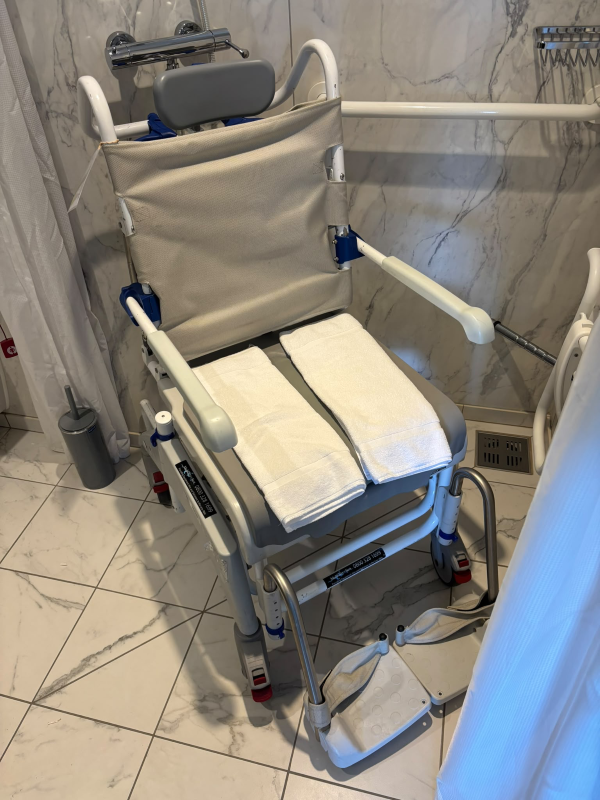
The accessible bathroom is only one part of the picture. Consider how you will get from the bed to the bathroom at night, especially if you use a wheelchair, walking frame or rollator. Check the route around the bed, the position of furniture and whether mobility equipment can be parked without blocking the bathroom door. A folding commode may be the ideal solution next to the bed space permitting.
Lighting matters too. A low-level night light can make a significant difference for someone who is unsteady, has reduced vision or needs the toilet during the night. If you use continence products, catheter equipment or medication, think about where supplies can be stored cleanly and within reach.
For passengers who use a mobility scooter, it is worth remembering that scooters are not generally suitable for use inside bathrooms. You may need a manual wheelchair, walking aid or transfer support for the final part of the journey. Planning this before departure avoids an uncomfortable surprise once you are in the cabin.
Accessible cruise bathrooms on older and newer ships
Newer ships often have purpose-built accessible cabins with more generous bathroom layouts, but newer does not automatically mean better for your individual needs. Cabin design differs across fleets, and the same ship may have accessible cabins in different locations or categories with slightly different arrangements.
Older ships can still offer very usable accessible accommodation, particularly where cabins have been refurbished. However, dimensions may be tighter, doorways may be narrower and bathroom layouts may reflect earlier accessibility standards. If your needs are straightforward, this may be perfectly manageable. If you need a hoist, a larger powerchair or substantial carer support, exact measurements become more important.
Cabin location can also affect your experience. A cabin close to lifts, dining venues or the medical centre can reduce the distance you need to travel, although a location near busy public areas may be noisier. It is a balance between convenience, privacy and the layout that works best for you.
A practical checklist before you travel
Before finalising your booking, confirm the cabin number and ask about its bathroom specifically. Make sure the cruise line knows about any equipment you are bringing or hiring, particularly items such as hoists, profiling beds, shower commode chairs and powerchairs. Cruise lines may have approval processes, storage requirements or safety rules, so do not assume that equipment accepted on one ship will be accepted on another.
It is also sensible to discuss your needs with your travelling companion or carer. Agree how transfers and personal care will be managed, what help is realistic, and what equipment would make the routine safer. If you need support at embarkation, in the terminal or between the port and your transport home, arrange this as part of the same plan.
Can I use my own shower chair on a cruise?
Often, yes, but it depends on the item, the cabin space and the cruise line's requirements. A chair that works well at home may be too wide for the bathroom door or difficult to position safely in a compact wet room. Confirm dimensions and approval before you travel.
Are all accessible cabins fitted with a wet room?
Many are, but not all bathrooms are identical. Ask whether the shower is level access, whether there is a lip, and whether a fixed or portable shower seat is provided. Photographs and measurements are far more useful than a general description.
Will a carer have enough room to help me?
Some accessible bathrooms provide sufficient space for a carer, but this cannot be assumed. Explain the assistance required and ask about clear floor space beside the toilet and within the shower area.
A well-chosen cabin and the right support equipment allow you to focus on the parts of cruising that matter most: time with the people you love, new places to enjoy and the confidence of knowing your personal care needs have been properly considered.