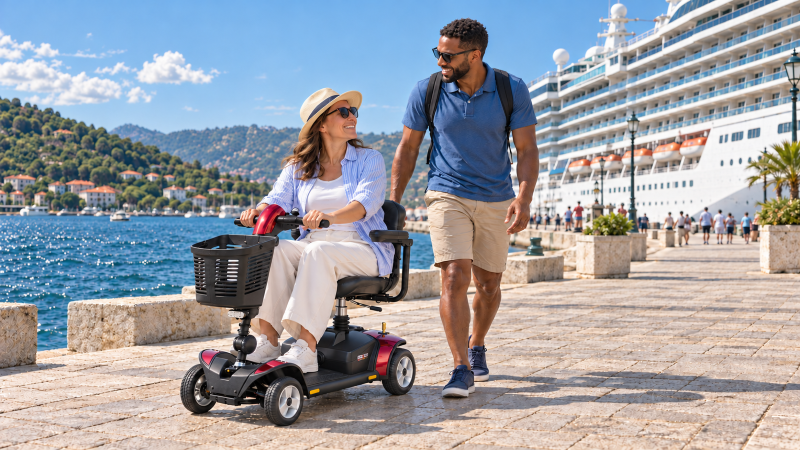
The difference between a memorable day ashore and a tiring, worrying one can come down to a few details: the height of a coach step, the distance from the pier to the town, or whether your scooter can travel with you. Accessible shore excursions make it possible to see more of each destination while protecting your comfort, safety and independence.
For some passengers, the cruise itself is the easy part. The uncertainty begins when the ship arrives in port. Will there be accessible transport? Is the route genuinely step-free? Can a wheelchair or mobility scooter be accommodated? Asking the right questions before you sail gives you far more choice, and much greater confidence when it is time to go ashore.
What makes a shore excursion accessible?
An accessible excursion is not simply one described as suitable for guests with limited mobility. It should match your own needs from the moment you leave the ship until you return. That may mean a vehicle with a lift or ramp, space to secure a wheelchair, a guide who can adapt the pace, accessible toilets along the route, and minimal walking over uneven ground.
Requirements vary widely. A guest who uses a folding wheelchair and can manage a few steps with support may have different options from someone using a larger powered wheelchair, travelling with an oxygen concentrator, or needing help with transfers. Accessibility is personal, so broad labels such as “easy” or “panoramic” are useful only as a starting point.
A well-planned trip also allows time. Even on a fully accessible route, boarding a vehicle, using a lift, or taking a comfort break may take longer than it does for other guests. A good excursion provider will allow for this without making you feel rushed.
Start with the port, not the brochure
Before choosing an outing, find out how your ship will berth. At a quay, passengers usually leave via a gangway, although its gradient can change with the tide. At a tender port, passengers travel from ship to shore in a smaller boat. Tendering can be unsuitable for some wheelchair and scooter users, particularly where sea conditions are unsettled or a safe transfer cannot be made.
This does not mean every tender port is automatically out of reach. Cruise lines assess tender operations on the day, taking account of the vessel, weather, passenger mobility and crew support. However, it is wise to treat a tender stop as less predictable than a berth and avoid making plans that depend on being ashore at a precise time.
Once you know the port arrangement, consider the setting. Historic towns can be beautiful but may have cobbles, steep lanes and narrow pavements. A sightseeing drive may be more comfortable than a walking tour, while an accessible beach transfer may require specialist beach wheelchairs that need booking in advance. Choosing an alternative is not settling for less. Often, it is the choice that lets you enjoy the place rather than endure the route.
Questions to ask before booking accessible shore excursions
The excursion description rarely covers every practical point. Contact the cruise line or independent operator early and explain the equipment you will be using. Give the folded dimensions and weight of any wheelchair or scooter, not just its model name. Ask whether it can remain with you throughout the excursion or whether it must be lifted, folded or stored separately.
It is also sensible to confirm the vehicle type, not simply whether it is “wheelchair accessible”. A low-floor minibus, adapted taxi and coach with a passenger lift offer very different experiences. Check whether the lift has an individual weight limit, whether tie-downs are available, and whether you can remain seated in your own wheelchair during travel.
Ask about walking distances in practical terms. “A short walk” can still involve 300 metres across cobbles, a long pier, or several steps at a viewpoint. Find out about gradients, ground surfaces, toilets, places to sit and how long you will have at each stop. If you travel with a companion or carer, ask whether they can stay with you at all times and whether there is space for any essential equipment.
Finally, establish the return arrangements. Excursions sold by the cruise line are generally planned around the ship’s schedule. If you arrange a private tour, build in a generous buffer for traffic, lifts, comfort breaks and unexpected delays. Keep the ship’s all-aboard time with you, and do not rely on a mobile signal alone.
Choosing the right mobility equipment for days ashore
The equipment that works well around a ship may not be the best choice for every port. A compact wheelchair can be easier to take in an adapted vehicle and manoeuvre through museums or older streets. A mobility scooter can offer valuable independence over longer distances, but it needs suitable storage, safe battery charging and transport that accepts its size and weight.
Battery range deserves careful attention. Hills, rough paving, heavier user weights and frequent stopping can reduce the range you achieve compared with a smooth indoor surface. Start the day fully charged, take your charger if it is practical to do so, and avoid assuming charging will be available in a café or attraction.
For passengers who can walk short distances but tire easily, a rollator or lightweight transit wheelchair may be the most flexible answer. It can provide a seat when queues are longer than expected and support when surfaces are uneven. The right solution depends on your ability, the itinerary and who is travelling with you.
When hiring equipment for a cruise, choose items approved for ship use and suitable for your cabin and planned transport. Mobility at Sea can advise on cruise-compatible scooters, wheelchairs and care equipment, with delivery arrangements coordinated for selected UK departure ports. This removes the need to transport bulky equipment from home and helps ensure it is ready when you board.
Plan for comfort as well as transport
A successful excursion should not demand all your energy simply to get around. Consider your medication schedule, hydration, temperature sensitivity and need for personal care. A scenic tour with regular accessible toilet stops may be more enjoyable than a full-day itinerary with little opportunity to rest.
Heat can be especially challenging in Mediterranean and Caribbean ports, where exposed quays and coach parks offer little shade. In cooler destinations, rain can make ramps and paving slippery. Pack layers, waterproof protection for mobility equipment where appropriate, drinking water, any essential medication and a small bag with the items you need close at hand.
If you use a hoist, shower commode chair, transfer aid or other care equipment on board, consider whether the time ashore is realistic without it. Some passengers prefer shorter independent outings near the port, returning to the ship for lunch and personal care. Others are comfortable arranging an adapted private vehicle with the space and privacy they need. There is no single right approach.
Independent days ashore or organised tours?
Cruise-line excursions can offer reassurance, particularly for first-time cruisers or guests who are concerned about returning to the ship on time. The cruise line will usually have assessed the operator and can coordinate support if arrangements change. The trade-off is that group tours may have fixed timings, limited places for mobility equipment and less flexibility to alter the route.
Independent accessible tours can be a good option when you want a slower pace, a particular attraction, or an itinerary designed around your needs. They can also work well for families travelling together. However, responsibility for checking accessibility, insurance, timings and the return journey rests with you, so clear written confirmation is worthwhile.
Staying close to the port is another perfectly valid choice. Many cruise terminals have accessible shuttle services, nearby cafés, waterfront promenades or adapted taxis. A gentle few hours ashore can be far more rewarding than an ambitious itinerary that leaves you exhausted for the next day.
A little preparation protects your independence
Book early where possible, especially if you need a lift-equipped vehicle or space for a powered wheelchair. Keep copies of confirmations, equipment dimensions and emergency contact details with your travel documents. Let the shore excursions team and guest services know about your needs before sailing, rather than trying to resolve everything on a busy port morning.
Most importantly, give yourself permission to choose what feels comfortable. Accessible travel is not about proving that you can do every activity offered. It is about having the support and suitable equipment to enjoy the moments that matter to you, at a pace that feels right.